Convergent Billing
The CMP Converged Monetisation Platform. The MDS Global product that supports customer care and billing for digital service providers. convergent In the telecommunications industry, a soultion that enables common management of all users and all services for multiple operators. billing engine can calculate and consolidate all chargeable events, mobile, fixed line Descriptive of a phone that uses a metal wire or fibre optic telephone line for transmission as distinguished from a mobile cellular line, which uses radio waves for transmission. Also called a land line., and/or broadband A wide-bandwidth data transmission that transports multiple signals and traffic types. related services onto a single customer In the context of the Cloud Monetisation Platform, an individual or organisation who has signed an agreement to take goods and services from a service provider. A customer receives a bill associated with one or more subscriptions, and can be a single end user or a large company with many subscriptions assigned to one agreement. bill.
CMP handles a number of different charge types, which cater for most types of service:
-
One-off charges
Any one-off charge to be billed to the customer. These can be applied at any level of the customer hierarchy.
One-off charges are normally for one-off bolt-on
An addition to a subscriber's main plan or product; also sometimes called an add-on. purchases or in response to a specific event, such as fees associated with connection or termination. These can be applied manually by a CMP user A person with the capability to log in to the CMP GUI software, such as a customer service advisor or agent., a customer using a self-care portal or as an automatic Action associated with a Workflow Event. -
Periodic charges
Recurring charges covering a configurable period. Periodic charges can be billed in advance or arrears. Charges for partial periods can be pro-rated. These charges can be applied at any level of the customer hierarchy.
- Periodic charges are normally a regularly recurring charge associated with the subscription A billing entity that incurs a charge. Examples include a network attached device whose usage you want to measure and charge for, or a monthly software subscription, such as line rental.
- Pro-rated charges are calculated based on an average 30.4 days in the month, or on the exact number of days in a month.
- Periodic charges are normally a regularly recurring charge associated with the subscription
-
Unit-based charges
Driven by xDRs, unit charges can be usage
The consumption of services, for example a subscriber using call minutes. or event based. These are typically sourced from a third party Of software; a reusable component developed to be either freely distributed or sold by an entity other than the original vendor of the development platform. such as a network In the context of CMP, the infrastructure on which usage of registered customers will be measured – this could be a mobile phone network, broadband network or other non-telecommunications network. using a secure gateway. The charge is determined by online rating In telecommunications, determining the cost of a particular call. Involving converting call-related data into an equivalent monetary value., or can be passed directly to the bill by the third party, see Charge Loader for more information. These charges are always generated at the Subscription level. Unit-based charges can be affected by allowances and discounts and are always billed in arrears. -
Adjustments
A mechanism to apply an ad hoc credit or charge to an account
In the Cloud Monetisation Platform, a billing entity that can be used to manage payments on one or more subscriptions or payments for services. An account can hold details such as payments or invoices.. Adjustments provide the functionality to apply a goodwill credit or reverse an incorrect charge from a previous bill. Adjustments are raised at the Account, Corporate or Group levels, and can form part of the next cyclical bill or be applied independently to trigger a credit note. Adjustments are manually applied by CMP users within AgentView The graphical user interface of the CMP that is typically used by Customer Service Agents to access CMP customer and billing data. In versions prior to CMP 8.0, this was called the CMP GUI. or by third party systems using CMP web services.
The applicable tax is applied to calculated charges, and billing data is output in the JSON JavaScript Object Notation. JSON is a lightweight format for storing and transporting data, often used when data is sent from a server to a web page. file produced by the Bill Print batch job for online display and paper bills to be produced by a third party print vendor.
The CMP Agreement In the Cloud Monetisation Platform, the entity that holds the instructions for generating the bills for one or more subscriptions. including the addresses and how often the bill is generated. determines the eligibility for billing in each invoice production run. The billing task itself is wrapped by pre- and post-bill assurance processes to minimise the risk and impact of billing errors.
Billing controls
The Agreement entity of the CMP customer hierarchy contains the controls for the frequency, structure and content of customer bills.
Key features are the following:
-
Bill Cycle
The day of the month when cyclical bills are triggered. This can be configured as any day between 1 - 31 days. See also Next Expected Invoice Date.
-
Invoice Frequency
The number of days or months between bills.
-
Next Expected Invoice Date
This is the date the Agreement becomes eligible for invoicing, and is a key factor in the selection criteria used by CMP to determine when to generate a bill for a subscriber
The end user of a network.. Each time the subscriber is billed, the bill cycle and invoice frequency are used to set the Next Expected Invoice Date to the appropriate future date. CMP automatically adjusts for short months. -
Consolidation Level
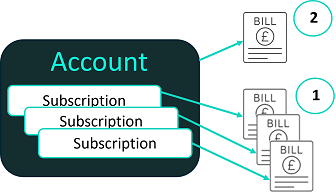
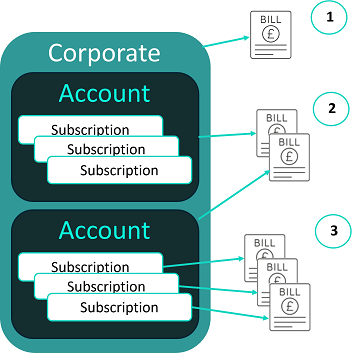
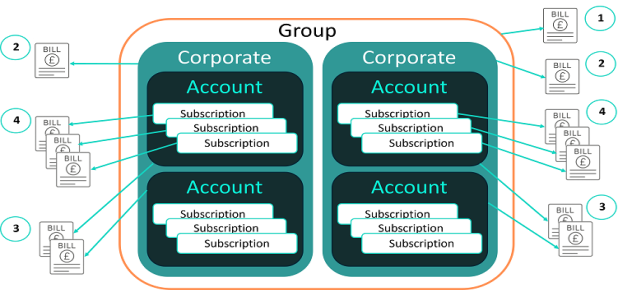
The level of the hierarchy at which charges should be grouped for billing. This ultimately determines how many bills are produced for the subscriber and where the debt sits on the customer hierarchy.
-
Billing Media
The media and format of the bills produced, for example e-billing, Braille or audio.
-
First/Final invoice controls
Govern when first and final bills are produced, either on the normal bill cycle, or a configurable number of days after connection or disconnection.
Consolidation
Agreements can be logged at Account level or higher on the CMP customer hierarchy. The level at which the agreement is logged determines the options available for consolidating charges into bills:
Account Level
Corporate level
Group level
Tax Calculation
CMP calculates the tax due in line with the tax requirements of national regulators through configurable Service Tax Codes.
Each billable Service has an associated Tax Code reflecting the applicable rate. Where charges exist against multiple tax rates on a single bill, a tax line for each tax rate will be output in the Bill Print JSON file.
CMP supports, but not limited to, the following tax concepts:
-
Inclusive Tax
Prices are configured in CMP as the VAT inclusive amount. During Invoice Production tax is split out totalled against the configured Inclusive Service Tax Code.
-
Exclusive Tax
Prices are configured in CMP exclusive of tax. During Invoice Production tax is calculated, applied and totalled against the configured Exclusive Service Tax Code.
-
Exempt Tax
If defined as Tax Exempt, no tax will be applied.
-
Reverse Charge
If an Account is flagged as eligible for reverse charge taxation, CMP does not calculate and apply tax for that customer. Reverse charge tax must be declared to the appropriate revenue and customs authority. The service provider
The owner of the infrastructure in which accounts will be created. The Service Provider can host and operate the instance of CMP, or CMP can be provided as a Managed Service. (seller) must include an acceptable method of notification on an invoice provided to the customer (buyer) stating the amount of tax to be paid. Reverse Charge VAT applies to:- business sales where the business is VAT registered
- goods purchased for a business purpose
- mobile phones and computer chips
The invoice must also come to a total of at least £5000 (ex-VAT).
Override Tax at Account
A Service Tax Code can be configured against a CMP Account in the Sales Ledger. When the Override Tax Code to A/C flag against the Account is set, the configured Service Tax Code is used to tax all Usage and Non-Usage items related to that Account.
Invoice Production and Print
Customer billing is typically generated daily but can be scheduled according to operational requirements. The one-off, periodic and unit-based charges are collated for each Subscriber deemed eligible for billing, based on their calculated Next Expected Invoice Date.
Charges and Credits are applied based on a CMP Service code. The behaviour of each Service Code is driven by underlying configuration during billing. A recurring service can be configured to charge in advance or in arrears and to prorate when applied or expired. Service configuration also drives how the associated revenue is reported in the ledgers and the tax rate applied to the charge. Tax is calculated against the sum of all charges for a tax code. CMP handles Inclusive, Exclusive, Exempt and Account Override for tax.
CMP collates charges for usage and events against services. It maps each usage classification to a Unit type service, which groups charges on the bill.
CMP creates invoice lines based on the chosen consolidation level where charges or credits exist.
CMP creates invoice lines based on Services for any identified non-agreement driven charges such as adjustments.
Once all invoices have been generated, they are posted to the sales ledger and the billing file is generated. This can then be transmitted to a print bureau.
Bill Formatting
The billing files, generated by the Invoice Print process, are used to generate the physical and/or electronic bills that are sent out to end customers and made available through the self-care applications and AgentView.
At the end of the billing process, the billing file is automatically transferred to the Bill Formatting system that is responsible for the generation of the PDF bill for distribution and enquiry.